Search This Blog

Thursday, August 18, 2011

A Chronology of the History of the Portuguese in San Diego

When I was asked by Mizé Ferreira, incoming president of the Luso American Fraternal Society, to be the keynote speaker at its convention in San Diego , I decided that a presentation on the chronology of the history of the Portuguese in San Diego would be a given, since this community has a certain mysticism among communities in California. 
The presentation was made on August 7, 2011.

In 1973 I vacationed in San Diego, and after a few days here, I decided that if I were to ever leave San Jose, the choice would be San Diego. 
Little did I know that just a year later, I would be moving to San Diego to pursue a business opportunity.
Shortly thereafter, I began my involvement in the Portuguese Community and learning about its history.
My first involvement was in the Cabrillo Civic Club #16. 
This gives me a perfect “door opener” as it relates the chronological history of the Portuguese in San Diego.
It was almost 469 years, to today, that the first Portuguese set foot on what is now San Diego and the West Coast of the United States. I am of course speaking of João Rodrigues,  Cabrillo, the name that was given him by the Spanish, whom he was in service of. And why the name Cabrillo?  
Most likely, because he was born in Cabril in Northern Portugal. Interesting enough, if one looks at a phone book in Portugal, one is hard pressed to find the name Cabrillo or Cabrilho.
After his death on San Miguel Island in the Santa Barbara Channel, it was around 300 years, before a récord could be found, of a Portuguese setting foot in San Diego.
We are now in 1852, when a captain José Machado, known as Joseph Clark, became one of the most famous whaling captains of his time, when he established the Monterey Whaling Company.
History tells us that Joseph Clark was asked to come to San Diego, around 1858 [1]by a Captain Packard, to help with the establishment of a whaling station at Ballast Point, Point Loma, just across from where Cabrillo is  believed to have landed.
Meanwhile, immigrants from the Azores had come to try their luck during the gold rush of 1849 in California. Many of these men were from the island of Pico and once they had tried their luck at gold mining, decided to look for other opportunities, like farming, dairying and fishing.
One man of these men was Manuel Francisco Madruga, who had been farming in Northern California.   After hearing stories about fishing in San Diego,  he decided to move his family to the La Playa area of Point Loma at about 1885, and try his luck at fishing[2], eventually becoming a successful fish broker.
As word spread of the good fishing in San Diego, other immigrants from the Azores and later from Madeira, found their way to Point Loma. The first marriage performed between two Portuguese in San Diego, was that of José Leal Monteiro and Maria Mitchell, (Machado), held in 1889.
From its inception, the economic base of the Portuguese community was fishing.  These pioneers engaged in,  salt fishing.
From 1885 to 1913 when the first cannery opened to can exclusively tuna, the Portuguese dominated this fishery.
As the members of the community became more prosperous, they used their profits to invest in land, and businesses related to fishing and boatbuilding.
They built small homes, with a community developing in La Playa first, and subsequently in Roseville. This was a lot different from the early comers, who had settle on La Playa and lived in wooden shacks with blue doors.
As the community grew, the influx of immigrants, now accounted for more people not only from the Azores and Madeira, also but from the “Continente”. They came from the east coast, mostly from Gloucester, Massachusetts, where they had been fishing. This last group settled mostly in the area known as “downtown” in San Diego.
These immigrant families, brought with them, the customs and traditions from their areas, and made these part of their daily lives, including the Festa Do Espírito Santo, that had begun to be celebrated at people’s homes in an unorganized manner.
From 1910 to 1913, a home belonging to Manuel Cabral, was used as a community hall for the celebration of the “Festa”.
Members of the community would bring the traditional food of the Holy Spirit Feast (Sopas) from their homes and share in the celebration. There was much merryment, and the celebration went on well into the night. There would be a small parade to St. Agnes Chapel, a mass and crowning. For this early celebration, a crown was made by the tinsmith Joe (José) Azevedo who had immigrated from Terceira.
Mr. Azevedo was also the first Portuguese to own a fish canery in San Diego, where he canned sardines. It was located in his backyard, across from the present St. Agnes Church.
As many of the Portuguese immigrants in those days were living in the downtow area of San Diego, the commute to Point Loma to attend s Festa, was done done by ferry. This posed a problem for those who lived downtown, for the celebration would many times last past the last ferry. This meant either staying at friends homes in La Playa, relying on one of the fishermen to return them by small boat or more likely, waiting on the beach for the first morning ferry. “Many times we walked up the boardwalk on Broadway (downtown San Diego) late at night with our shoes in our hands, for we were tired from walking and dancing”, wrote Lawrence Oliver in his autobiography, “Never Backward”, published in 1972.
For those who were Point Loma residents, either from La Playa or Roseville, it also meant a night of great enjoyment, for the celebration would mean listening to the music of Frank Goularte and his viola, as well as the dancing of the  Chamarrita.
In 1913, a crisis in the family of Manuel Cabral made it impossible to continue using the home as a community hall.
A group from the downtown Portuguese community, who at that time were enjoying a more prosperous financial situation, spearheaded a move to build a community hall in the Roseville area of Point Loma.
The building was named the Cabrillo Pavillion, and was used as a community hall from 1914 to 1921.
Although used for community events, even the Festa organizers had to pay for the use of the Cabrillo Pavillion. Miss Aurora Mitchell (Machado) was the first Festa Queen in this hall.
In 1920, Frank Silva, an immigrant from the Cape Verde Islands, coordinated a drive to buy a crown so that the Portuguese Community could in an organized manner, celebrate the Festa do Espírito Santo. This crown is still used today at the annual Festa.
In 1921, a group of immigrants from the La Playa community decided that an Irmandade should be formed and that property be purchased in its name to build a community hall.
There was a break between the two factions, from Downtown and La Playa.
The old group moved the Festa to Downtown. The Cabrillo Pavillion was then turned into apartments which became the home for many Portuguese for the next 40 years.Until 1963[3], San Diego had two Festas. The Downtown Festa and the Point Loma Festa.

As a gesture of perpetuity of the Downtown Festa, the gold crown that the Olivers had acquired in Portugal for this celebration[4] was placed in a chapel consigned by Lawrence Oliver at the Imaculata at the University of San Diego,[5] where it remains.
The Festa da Trindade as it was known, was celebrated on Trinity Sunday.
The move to organize an Irmandade, and a new hall was led by M.O. Medina and the Medina Family. Lore has it that M.O. Medina’s father made the statement, refering to the Cabrillo Pavillion, “O Senhor Espírito Santo não paga renda a ninguém”-   the Holy Spirit pays rent to no one.[6]
The first major goal was to purchase the property for the community hall and chapel.
Donations were solicited from the Portuguese community in San Diego, as well as from other Portuguese Communities dispersed throughout California.
Two men stepped forward, Manuel Correia from Madeira and Joe Rodgers (José Rodrigues) from Pico and offered to lend $500.00 each to buy the property, with the stipulation that they would be rehimbursed by the Irmandade.
In order to clear the debt, tuna fishermen pledged one day’s catch in the summer of 1921.
 As construction on the new hall began, each boat also pledged the labor of one fisherman for the duration of the construction, making sure that  the fisherman fully shared on that trip’s catch.
Of special interest is the Chapel located adjacent to the hall. The design draws on the architecture of the Impérios of the island of Terceira in the Azores.[7]
Thus was created, in 1922, the United Portuguese Sociedade do Espírito Santo (U.P.S.E.S, Inc.), Point Loma, San Diego.
As tradition dictated, each year a president (Mordomo) was picked and the feast was celebrated on Pentecost Sunday.
He or she was chosen by a committee from the U.P.S.E.S. with preference given to those who had made a Promessa (a promise) of thanks for a Divine intervention.
In 1929, a new way to choose a feast president was agreed upon.
Instead of individuals, tuna boat owners and the crews became responsible for celebrating the Festa by donating 50 cents per ton of tuna caught to offset the expenses.
As chance would have it, M.O. Medina, the man credited with starting the commercial tuna industry in the United States and his tuna boat, “Atlantic”, was chosen as the first president under the new system.
From 1929 to 1948, the Festa evolved from the very traditional style as was celebrated in the Azores, more specificly in the island of Pico, to the rather elaborate affairs of today.
Before 1948, the Festa was celebrated with daily activities beginning the Thursday prior to Pentecost Sunday, and continuing until the Monday after Festa Day.
From early on, the Portuguese fraternal organizations played an important role, always participating in the parade.
The competitive spirit of the community was evident from the begining of the celebration of the Festa. Every year, there were changes made either to the parade and or the manner in which the participants were dressed.
In 1921 a drill team was organized by the U. P. P. E. C. and became a part of the parade.
This was followed in 1937, by the introduction in the parade of the first King.
The king and aids walked inside the Varas, along with the queen and side maids. The reason was that - “the boys could not walk straight by themselves”.[8]
The introduction of statues of saints, marching bands and of alegoric floats became commonplace.
As an added bit of flair, since the hall was so close to San Diego Bay, the host tuna boat would be decorated with lights, flaggs and garlands. On Saturday evening, fireworks were set off from aboard.
Today, the parades have become trully coreographed events, with many children dressed in the representative costumes of many religious and historical personages related to catholicism and Portuguese history.
In many instances, more than 1000 children participate in the parade. Floats and children dressed as tuna fishermen pay special homage to the tuna fishermen that have been the heart of this community.
The high mass and the crowning of the Festa Queen, family and friends, is done in a most solemn maner, many times with a Bishop or priests, who are especially invited from Portugal, officiating. Accompanying, is always the Portuguese Choir of St. Agnes Church.[9]
As early as 1932, the community recognized the need for a larger, more modern hall, even though additions had been made to the original hall.
Again, a novel way was used to raise funds for the new hall.
Each tuna boat would contribute 25 cents from every ton of tuna caught toward the construction. This fund raising went on until 1948 when the new hall was completed.
For the dedication of the new hall, the community went to great lenghts, inviting dignitaries from near and far, from governmental officals to embassadors and consuls.
An elaborate ceremony with the Hollywood star, Harold Peary, of Portuguese descent, as master of ceremonies, officially opened the new hall.[10]
In the week prior to the Festa, the finishing touches are put on the event. All the work that had begun one year earlier is now coming to fruition. The hall has been spruced up, the kitchen is ready, the decorations are up.
 It is also during this last week, that the rosary is prayed before the Corôa, food is served to those in attedance, all followed by the dancing of the Chamarrita.
On Saturday night, an evening parade departs from the hall to St. Agnes Church for the handing over of the crown from the previous year’s Queen to the present Queen to be.
The annual Festa’s traditional “Fish Fry” has also greatly abled the Hall to stay a viable and strong part of the community and unique to San Diego.
On the Friday before the celebration, the Irmandade invites tuna boat captains, canery representatives, members of the business community and selected members of the public, who are delighted with a fried fish meal of exquisite proportions and drinks.
They are asked to bid on the most varied items, from gift baskets to chain, and from sweet bread loaves to outboard motors.
There is an aspect of the Festa do Espírito Santo which has not changed since it’s inception in San Diego, the Sopas do Espírito Santo, the traditional stewed meat (carne de môlho) flavored with spices, and linguiça, served with boiled potatos, and “sopas”, Bread, fresh mint, cabbage and kale.  To top off the meal, Sweet Bread (Pão Dôce or Massa Sovada) is served for dessert.
Annually, the San Diego Festa do Espírito Santo serves between 3,500 and 5,000 attendees. 
A main seating takes place when the parade returns from the church and the crowned Queen is presented to the public.
At this main seating, attendees are the Queen and her entourage, the Festa President, family members, dignitaries, members of the Board of the U.P.S.E.S., Inc., and invited guests.
As part of the tradition of the Festa, the kitchen keeps a list of members in the community, who have contributed to the Festa in a special way and cannot attend, the sick, families who have lost a family member since the last festa and special requests.
On Sunday, Festa Day, volunteers deliver to 100 plus  homes, pans of Sopas, as an offering from the Festa do Espírito Santo.
The bazaar or (arraial) has also been a prominent part of the Festa. Started in 1955, during the Festa of Edward and Deutilde Varley,[11]  traditionally this is the place one meets old friends, enjoys the music of brass bands, eats the food of the motherland, including linguiça, barbequed sardines, bacalhau, takes chances on the many games that help support the Festa and enjoys the entertainment of the folkcloric group, Portuguese American Dancers, founded in 1955 by Mary Moniz.
Greatly missed is, the Point Loma Strings (António Garcia da Rosa, Lionel Garcia da Rosa, Manuel (Frizado) Silva, Manuel Labricha and later José Correia), who were an important part of the entertainment  and dancing during the Festa.
In the evening, in the hall, there is a Grand March and dance which includes everything from the top 40, swing, line dancing, rock n roll and the “Chamarrita”.
In the middle 60’s, the old method of choosing the Festa president was revived. Names of those interested in making the Festa are put into a hat and a name pulled at 10 P.M.
The Festa das Contas is held on second Sunday in January.
In the 1980’s, once again, the community saw a need to modernize the hall. In 1989, a total renovation of the hall was completed in stages under the direction of Basílio Freitas.
Today, the U.P.S.E.S. Hall in San Diego is one of the best equiped and most confortable halls, of the many Portuguese Halls in California.
From its onset, San Diego’s Festa queen capes have been recognized for their beauty, intriquesy of the embroidery, and design.
They were trully different from other Festa capes in California, indeed anywhere. Expense was not spared to make the cape a true work of art.
Originaly they were bought “up north in Artesia”.[12]  In later years, many have been the community seamstresses who have worked in these works of art.
One other event that takes place in San Diego is the “Weekly Crownings. Due to the overwhelming popularity of families wanting to host the Festa do Espírito Santo, and since there were not enough years to accommodate everyone, it was decided by the U.P.S.E.S. Board, that on the weeks following Easter leading to Pentecost Sunday, a family could in fact have a mini Festa and crowning and prepare a meal for family members and friends.
In the week preceding the crowning the family and invited friends pray the rosary in their homes every night, before the crown.
This has proven so popular and so many families have signed the “Weekly Crowning Book” that at present, it extends to the year 2078.  In many instances,  names are placed in the book prior to, or at the birth of a child.
In 2010, with Evelyn daRosa Feliciano as President, the U.P.S.E.S. Festa celebrated its 100th anniversary with much pomp and circumstance.
Of note is the fact that San Diego’s Festa do Espírito Santo is the oldest religious festival in San Diego.
In 1993, a group of community members who had been privatly celebrating the Festa da Trindade, or old Downtown Festa, asked the U.P.S.E.S. to sanction their Festa. It was agreed.
San Diego, once again, has two Festas, one on Pentecost Sunday and the other the following week, on Trinity Sunday.
But, lets return to the 1892 and the first commemoration of the arrival of Cabrillo 350 years hence, as Manuel Cabral, played the personage of Cabrillo at a citywide commemoration sponsored by the city fathers.
This commeration was not to be repeated until the arrival of the Cabrillo statue, that now sits atop Point Loma at the Cabrillo National Monument.
By 1893, there are reports of the fishing for “bonito” by the Portuguese[13]. The La Playa community continued to grow and so did the fishing, mostly coastal, for bonito and albacore.
The Portuguese immigrants had been observing how the Japanese and Italians were fishing,  going out in the morning and returning in the evening with their catches.
Among these men, was Manuel Oliveira Medina, who had come from the Azores to farm, and later wound up in San Diego to fish.
Astute and observant, in 1919, M.O.Medina, built his first tuna boat, Oceana. It was constructed by Manuel Madruga Jr. in his backyard in the old town area, not far from here. Medina paid for the boat within a short time, always with his sights set on larger boats.
As fishing became more productive, and the fishermen got better at using the barbless hook devised by the Japanese, there was a need to go further out and search for the schools of tuna.
This required larger and better equipped boats that could spend time at sea and only return when full. Therefore, in 1926, M.O Medina, consigned the building of the Atlantic, a boat equipped with ice chambers that could go out for longer periods of time, yet maintaining the fish fresh for unloading upon its return to the cannery in San Diego.
This was closely followed by the building of the Lusitania, owned by Manuel Garcia da Rosa and bother’s António and Lionel.
By 1929, M.O. and his boat the Atlantic, were fishing for the first time below the Equator, and thus an industry was on its way to making San Diego the Tuna Fishing Capital of the World.
A most important contribution to tuna fishing was the finding of banks in the Pacific Ocean, many of them discovered by the Portuguese tuna fishermen and have names like: Picaroto Bank, Rosa Bank and Lucky Strike.
With the growth of the community in La Playa and Roseville, there was a need to establish a church in the area. In 1908, under the direction of Father Mesny, a church was built. It “was a small, wooden structure built by the men of the parish, with a square steeple topped by a cross. The interior was wood with a central altar over which was a statue of St. Agnes.
The new church became the hub for community activities. The Festa do Espírito Santo was now celebrated at the new church, with the social activities taking place at the Cabrillo Pavilion. 
As an established tuna fishing industry prospered, so did the number of Portuguese families become larger.  This caused a need for a larger church.
“Several fishing boats started saving money to build the new church.
About fifteen boats gave 25 cents per ton of fish.
There were also requests for a Portuguese speaking priest.
Finally, in January of 1933, Father Rose, on loan from the Diocese of San Francisco, arrived to build a church and preach in Portuguese as well as in English.
Plans had already been drawn by Father Roure, pastor of Sacred Heart, and $3,000 to $5,000 had already been collected by the fishing boats.
With his admonition to do no work for which money was not on hand, the bishop granted permission to proceed with the lowest bid of $6,898 plus $100 for metal lath, and the project started.
The country was still in the height of the Depression. Often boats could not sell their catches, or catches were falsely condemned by canneries unable to buy.
Boats lay idle and so, some of the men came to help at the construction site.
While the church was being constructed, Mass was said at the Portuguese Hall.
The new St. Agnes church was dedicated by bishop Cantwell of Los Angeles-San Diego on May 4, 1934 and a solemn mass followed.
Father Rose continued at St. Agnes until 1936, when he returned to the Diocese in San Francisco.
An affable person, he was well liked in the community and prior to his leaving had been able to save enough money to build a rectory.
He was replaced by Father Forrestal, who was born in Ireland.
Father Forrestal did not speak Portuguese, however, “he learned Portuguese on his own by listening to records and with the help of friends.” His first Sunday, he preached in English. By the second Sunday, he preached at one mass in Portuguese.”[14]
“By 1946, a new St. Agnes School opened was dedicated by Bishop Buddy on September 15. It was administered by sisters of St. Joseph of Orange until its closing in 1970”[15]
In 1947, Father Edward Creighton arrived. Under his direction, the church was widened in 1950, and stained glass windows, imported from Ireland were added.
Soon after, the property across the street from the church became available and “and parishioners insisted that Monsignor Forestall buy it.”[16] The church hall was built in 1957.
After Monsignor Forrestal departure there were several care take priests, among them Father Lawrence Avila who became an assistant to Father McDonald being followed by another Portuguese speaking priest, father José Lopes from Portugal.
Today St. Agnes  is a modern church, with a renovated school, now called the Parish Center.
Over time, many members of the community have contributed to church activities. Among the participants in church events have been the Portuguese choirs that have embellished church events from the Sunday Mass, to weddings, the Romarias, the “coronation masses, special church events and even funerals.
St. Agnes to this day continues to be the religious center of the Portuguese Community in San Diego.
Today, the Portuguese community has become dispersed, and can be found in many parts of San Diego County, away from Point Loma.
Even with less and less Portuguese speakers in the community,  the importance of St. Agnes Church has not diminished, for where ever members of the community live, Point Loma continues to be where their roots are, and St. Agnes is the their church of choice for weddings, baptisms, first communions and funerals.
Returning to the mainstay of the community, more and more boats were built, many of them the design of Manuel Madruga Jr. at the now defunct Campbel Industries, where many of the men in the community were also employed in shipbuilding.
As the community grew in importance, it was decided that an organization should be formed by all of the local fraternal, civic and social organizations. This was to receive visiting entities from Portugal. Thus the Portuguese American League was formed in 1936.
As with other communities, San Diego was not immune to differences. As a result, the Portuguese American Social and Civic Club was founded in 1940.
Just as in other cities and towns in California, Portuguese fraternal organizations, flourished with the opening of local councils. Among them was of course the Luso, which became one of the more active local councils, especially after the founding of the Festa do Bom Jesus Milagroso, spearheaded by José Tavares.
In 1940, the Cabrillo National Monument was dedicated in Point Loma.
After a turbulent trip through New York, where the Cabrillo statue, a gift from the Portuguese Government, was to be exhibited at the New York Exposition of 1939, it was sent to the San Francisco Bay area, where it was to be part of the Golden Gate International Exposition in 1940.
As it turned out, it was not exhibited at either location and went into storage, at a private home in Oakland, until Lawrence Oliver found out.
I should mention that Lawrence Oliver was to the San Diego, what Donald Trump is to New York.
As a young man who came from Pico, without education, he became one of the premier entrepreneurs in San Diego, having interests in the tuna industry, processing, real estate, cattle raising and banking. He served in many boards, including that of San Diego Gas and Electric.
Returning to the Cabrillo Statue that was sculpted by Alvaro de Bré, it was in essence stolen from the Oakland garage where it had been stored, and brought to San Diego with the help of Colonel Fletcher a state senator, who was a friend of Lawrence Oliver’s.
It sat in storage until 1949, when it was initially place near the light house on Point Loma, and later moved to its present location.
Sacramento, Fresno and Oakland wanted it, but with a bit of ingenuity and lying, San Diego got it!
By 1964, a local committee was established to form the Cabrillo Festival Inc., Organized by the Point Loma Junior Chamber of Commerce, it has, from its beginning, had the invaluable support of the Portuguese Community.
Special credit must to be given to Mary Rosa Giglitto, recently passed, under whose direction and efforts, the Festival grew to become the premier international festival in the United States, involving  four nations, the United States, Portugal, Mexico, Spain and Native American Groups.
By 1940, as the tuna industry and its technology continued to develop, new techniques were found and so this same year, the tuna boat Endeavor, owned by Victor Goulart was built, the first boat to have a freeze-drying system to conserve the tuna.
With the beginning of WWII and specifically with the attack on Pearl Harbor, the US Navy mobilized  all tuna boats.
Some 600 fishermen, mostly Portuguese, enlisted in the Naval Reserve.
Shortly after being painted navy grey, and armed with bow cannons, the tuna fishing boats were sent out to sea. They were given the designation of YP’s (Yard Patrol).
Among these boats, there were several boats that were sunk, including:

The YP277 (Triunfo)
The YP284 (Endeavor)
Other boats included, the Navigator and the Yankee.

The YP346 (Prospect) commanded by Joaquim Theodore was damaged.
It is important to note that Jack, as he was known, and some of the other boats, were the reason that many service men and women had turkey to eat at Thanksgiving, for due to the cold capacity of the boats, they were able to transport frozen turkeys to the various combat zones.
Most important is the fact that Jack’s boat shuttled marines behind enemy lines during the Campaign in the Solomon. His achievements are included in the book, Guadalcanal Diaries.
For his bravery and wounds,   Jack Theodore was awarded a Purple Heart.
With the end of WWII, the men returned and built new boats.
By 1949 tuna fishing was evolving again. The Espírito Santo was the first boat to be equipped with a helicopter for spotting schools of tuna.
In the mid 1950’s a new way of fishing was introduced in San Diego. Originally used by the Slavs in San Pedro, purse seining became the norm.
Purse seining is a method, whereby a tuna boat carries a large net that is released from the stern of the boat and is pulled by a skiff, a small boat, until it encircles the school of tuna.
Men in speedboats then round up the tuna, much as cowboys round up cattle, forcing the fish to stay in the net.
Slowly the net is pulled until it has the form of a purse and the tuna cannot escape. The tuna boat then does, what is known as a back down procedure, where any dolphins that are in the net are allowed to escape, many times with the men swimming in shark infested waters to save the dolphin. The net is then pulled tight and the bringing of the fish into the boat’s holds begins.
It sounds simple, but it is a most complex procedure, with much danger to the men.
The first Portuguese fisherman to convert his bait boat to purse seining, was Lou Brito. Brito was also to create one of the largest commercial tuna fishing consortium.
As the purse seining became common place, the need for larger boats adapted  to the new technology were built.
By 1955, Manuel Madruga, Jr. retired from Campbel Industries.
In 1956, a boat builder from Pico, became the principal designer at Campbell Industries. It was time for José Vitorino Silva to have his hand at designing the award winning tuna boats that we all have become familiar with.  The slick lines of the modern tuna boat came from the pencil of Joe V. as he is known. They represent some of the most beautiful lines ever drawn, smooth as an ocean wave.
By 1965, the fleet had completely changed their technology to purse seining and it was on its way to becoming the tuna industry, without parallel.
New vessels with larger capacity and longer range were designed, new navigation equipment introduced, fishing techniques were improved and new ones found.
All of these factors led the San Diego tuna industry to become the best, most productive, efficient tuna industry in the world and its fishermen, to become the best rewarded.
One last evolution in the fishing of tuna was the Medina Panel.
Designed by Harold Medina in the 1970’s, it seemed to be an answer to fishing for Dolphin Safe Tuna. The Medina Panel is  a fine mesh net that is attached to the upper part of the net to facilitate the exit of dolphin from the net during the back down procedure.
Continued government regulations, made it impossible to sustain tuna fishing as it had been done before, and so its decline in San Diego began in the late 1970’s.
The development of the tuna industry accompanied the growth of San Diego. Those days are no more. The industry’s one hundred and fifty plus boats are gone. San Diego’s loss, the loss to United States fisheries, is now growth for others. Socio-economic winds and political expediency, made an industry fade into the history books. But as time moves on, and memory of what once was the mightiest tuna industry in the world becomes dimmer, names such as Medina, Correia, Rosa, Brito, Madruga, Silva and many more, will never be forgotten.

There are couple of other dates that I feel are important to note. In 1975, The Azorean Alliance was founded. It was an attempt to bring together the Portuguese Communities in California, at a time shortly after the 1974 revolution in Portugal, when it was felt that Portugal would go communist. It was a way of alerting the Portuguese in California of the importance of becoming politically involved in their communities and defending Azorean interests.
This concept was not to be, but the Azorean Alliance has become one of the most Portuguese organizations in San Diego, with its premise now being that of a social club.

In 1977, after a number of books were given to the Portuguese Community in San Diego, and no one wanted to received them, for they feared that their content was left wing inspired, they became the foundation for the founding of the Portuguese Historical Center. By the way, the books were about Portuguese literature and history.
The PHC, over the years has evidenced itself as the repository for the history of the Portuguese Community in San Diego, and well worth a visit.

From the mid 1970’s to the mid 1990’s San Diego also had a Portuguese radio program under the direction of Paulo and Angela Goulart by the name of Hora Portuguesa.

In 1986, on Shelter Island, the Tunaman’s Memorial was dedicated,  Honoring those that built an industry and remembering those that departed this Harbor in the Sun and did not return.”  
The concept and design was coordinated by Captain Anthony Mascarenhas, under the auspices of the Portuguese Historical Center and depicts three tuna fishermen pulling in a giant tuna in the old style of pole fishing.

In 1992, the city council passed for the street name that connects the Portuguese Hall to Saint Agnes church, to be changed to “ Avenida de Portugal”
In 1999, a marching band was formed. The Filarmónica União Portuguesa de San Diego, now delights the community at Festa time and at many other events.

Originally a community of fishermen, San Diego’s Portuguese Community is now made up of the most diverse professions. From attorneys to dentistis, from teachers to construction workers to entrepreneurs.
An amalgam of immigrants and their descents from the Azores, Madeira and the “Continente”, even with all their regional differences, has melded into a very distinctive community, for it has drawn from all of the traditions and customs of the various origins, and formed  a vibrant community, where the young are interested more than ever, in their past.

My presence in San Diego as I told you dates to 1974, when, as I believe it occurs in many of your home towns, the older members of the community questioned, whether the community would withstand the change of time.
I can tell you, that San Diego is alive and well, and that it will continue to thrive. It will become different from what we experience now, but just as it evolved from its simple beginnings, so it will continue to do so, for being Portuguese is not being stale, but an ever changing process that we all have experienced.
©José M. L. Alves 2011 


[1] Portuguese Shore Whalers of California: 1854-1904

[2] The Holy Ghost Festas A Historic Prespective of the Portuguese in California 2002
[3] Oliver, Lawrence,  Never Backward, 1972
[4] Lauriano, Gertrude  Conversation with José M. L. Alves P.H.C. 2001
[5] Oliver
[6] Medina, M.O. PHC Conversation with Claire Alves, 1981
[7] Medina, M.O. PHC Conversation with Claire Alves, 1981
[8] Labruzzi, 2001
[9] Rose, Phyllis – Conversation with José M. L. Alves 2001
[10] Commemorative Program 1948
[11] Varley, Deutilde - Conversation with  – José M. L. Alves P.H.C. 2001
[12] Varley
[13] A Chronology of the Portuguese Presence in California – 2011 PHPC
[14]            St. Agnes Church Golden Jubilee,1983
[15]            St. Agnes Church Golden Jubilee,1983
[16]            St. Agnes Church Golden Jubilee,1983

Monday, August 15, 2011

THE TUNA / PORPOISE CONTROVERSY


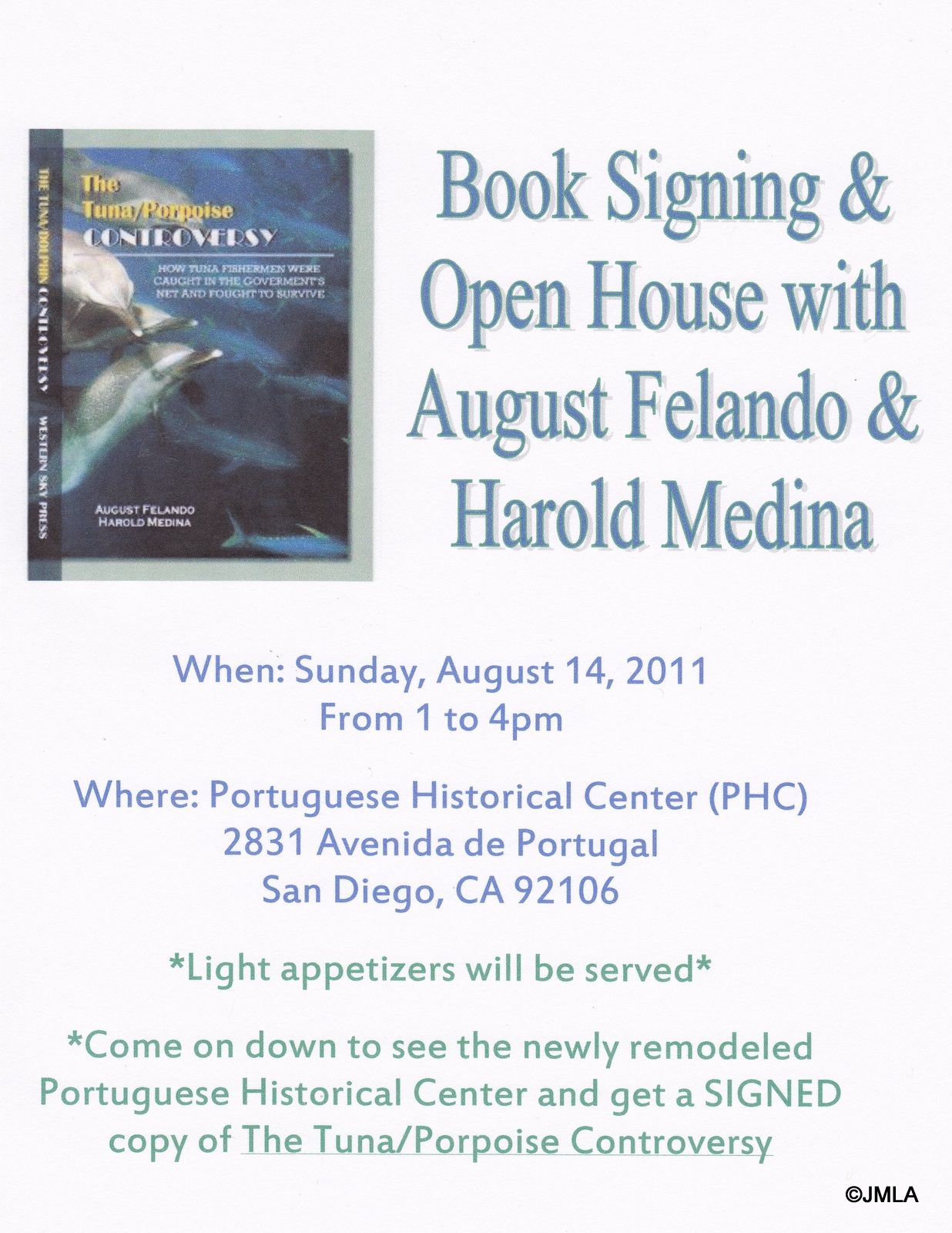
Yesterday, August Felando and Harold Medina made a presentation of their book, THE TUNA / PORPOISE CONTROVERSY – How Tuna Fishermen Were Caught in the Government’s Net and Fought to Survive, at the Portuguese Historical Center in San Diego. Self published by the two authors, it was a truly memorable afternoon.
Their expertise is well exemplified by the synopsis they presented. Harold’s and Augie’s experiences are unique to the two men, yet representative of an industry that renovated itself to survive, with innovations that were based on experience.
Harold Medina’s description of his lifelong passion, tuna fishing, began at age eight. His stories are captivating exemplifying the progression of a pre-teen young man to one of the most respected tuna captain / owner in the fleet, culminating with the invention of the Medina Panel to help porpoise survive when caught in the tuna fishermen’s net.
August Felando’s experiences are just as rich, showing his early days as a fisherman to his progression to a maritime attorney and defender of all rights of the tuna industry.
His accounting of the details of an industry trying to be understood by a government influenced by the political expediencies of the day, are detailed and forthcoming in making the layman understand the steps that were taken, the defenses made and the reasons for the demised of an industry whose methods were misunderstood by many.
It is recommended reading for those who want to be informed. It sheds truth and understanding on the many lies that were perpetrated, and makes one understand that the tuna fishermen were the first to support sustained fishing, for it was their livelihood!
I could have spent hours listening to both men. Even though I never fished, I have great affection for these men, their courage, tenacity, vision and resolve.

It was gratifying to see the number of retired tuna captains and family members attended the event.
As an ex-tuna captain and owner who attended the book presentation said after listening to the presenters and their accounts, “I too, finally gave in, because the industry turned to bureaucrats to run it, when we, who knew what we were doing were the scientists”.
Congratulation to Augie Felando and Harold Medina for a job well done!
Congratulations to the Portuguese Historical Center for promoting the afternoon and returning to its roots!
Cultural events if presented well are always supported!
JMLA 


Tuesday, August 2, 2011

WE ARE NOT IN THE MOODY'S - powered by Portugal

Book Signing and Open House with August Felando and Harold Medina

This is a wonderful opportunity to learn about the demise of the tuna industry in San Diego, from men who were directly connected with the attempt to keep alive an industry that had no parallel.

California American Portuguese Veterans’ War Memorial

Calling all Portuguese American  Veterans and Interested Individuals and Organizations.

Established in 1933 by local Portuguese American community leaders, the American Portuguese Club Inc. (APC) is a non-profit, community service organization. As a community organization, APC is dedicated to supporting the Portuguese American history. We are promoting a state resolution for the construction of the California American Portuguese Veterans’ War Memorial.  When the Memorial is dedicated, it will emerge as a significant and visible commemoration to all California American Portuguese, men and woman who honorably sacrificed their lives for our country. This monument would officially recognize our veterans and educate visitors, of the military contributions made by thousands of American Portuguese of California. The dedication ceremony is tentatively scheduled to be celebrated, at California’s State Capitol Park – Veterans’ Memorial Grove, in June 2012 to coincide with California legislation SCR79 “California Portuguese Heritage Month”.  We are asking leading California Portuguese organizations for support in this epic undertaking.
In hopes to bring us all together, there will be an open forum on Saturday, August 27, 2011 starting at 2:00 p.m. at the Cabrillo Civic Club located at 4605 Karbet Way in Sacramento.
Please RSVP
Al Balshor at 2661 Riverside Bl. Sacramento, CA 95818, or Loretta Kanelos at (916) 684-7041 or lkanelos@frontiernet.net no later than August 22nd. Light refreshments will be served.  If you have any questions, please contact us; we are excited to share our information with you. We look forward to your supportive response of this historic undertaking.

Sincerely,

The California American Portuguese Veterans’ War Memorial Committee, American Portuguese Club Inc.
Gus Kanelos, Albert Balshor, Eddie Maria, Manuel Perry, Rod Rosa, Wesley Silva, and Monica Souza

Subcommittee Correspondence: 2661 Riverside Blvd. Sacramento, CA 95818 ~ (916) 684-7041

Monday, July 18, 2011

Alberto S. Lemos 1921-2011 by Monica Lemos

                                          Photo http://www.tribunaportuguesa.com/

Alberto dos Santos Lemos passed away on Thursday evening, July 7, 2011 at
the age of 89 after struggling with lung disease. Alberto was considered both
a leader and voice of the Portuguese-speaking community of California
through his work as owner and editor of the Jornal Português for 39
years.

Alberto, born in Rio de Janiero, Brazil on September 9, 1921 and
raised in Portugal, emigrated to the USA in 1955. Alberto’s mother
(Elvira Almeda Santo Lemos) moved the family from Brazil to Portugal
when he was four years old. His father (Casimiro da Costa Lemos)
continued to work for a number of years in Brazil to support the
family. Together, Alberto, his brother Afonso, his sister Marina, and
his mother lived in Caria, Concelho de Moimenta da Beira, Distrito de
Viseu.

After four years his father returned from Brazil and moved the family
to Lisbon. Alberto finished his schooling and worked in Lisbon for a
number of years. During WWII he worked at the British embassy for
four years, an experience he later credited for being a seminal
influence. During that time he earned his first college degree at the
Instituto Comercial de Lisboa and the British Institute and completed
additional studies in English and French. After the consulate he
worked at the Bank of London and South America (BOLSA) in Lisbon for
10 years.

In 1955 he was sponsored by Maria and Artur Gonçalves (of Neto Sausage
in Santa Clara) and emigrated from Portugal to the United States. In
1957 he acquired the Jornal Português (The Portuguese Journal), a
weekly Portuguese language newspaper which traces its origin back to
1888. During his time as owner and editor of the Jornal, Alberto
obtained a certificate in Journalism from Laney College in 1974 and a
Bachelor’s degree in Mass Communications and Latin American Studies
with Honors from California State University at Hayward in 1976.

Through his work as owner and editor of the Jornal Português
(originally in partnership with Manuel Bettencourt who left the paper
after a few years), Alberto came to be a community leader and
representative, a voice for and of the Portuguese speaking community
of California according to many of his contemporaries. Through the
Portuguese Journal Alberto advanced many Portuguese causes and the
political voice of the Portuguese speaking community. To maintain his
journalistic integrity and neutrality, he did not participate directly
in many Portuguese social organizations but he did help to found
Portuguese Americans for Political Action (PAPA). The Portuguese
government recognized his work by bestowing him with the Medal of
Merit for service to Portuguese communities and inducting him into the
Order of Prince Henry the Navigator.

Alberto owned and operated the Jornal Português from 1957 until 1994
when he sold the newspaper. After his ‘retirement’ he continued to
volunteer his time for the newspaper until it closed in 1997. Later
in his retirement, until 2010, Alberto traveled to Portugal annually
to keep in touch with family. He was an avid reader, a real estate
investor, and maintained an active interest in serving his peers and
community through the Contra Costa County Advisory Council on Aging.

Alberto is survived by: his sister Marina of Portugal, her
daughter/his niece Teresa; his nephew Luis (son of his deceased
brother Afonso Lemos); by his ex-wife Heike: son Henrik (married to
Andrea) and his granddaughter Naomi all of Rochester, NY, daughter
Monica of Richmond, CA; by his second wife Marcia and his
step-daughter Maiza (married to Fernando) and his step-granddaughter
Johannah.

Personal Note: I had an opportunity to meet Alberto S. Lemos at the home of his sponsors, Artur and Maria Gonçalves (Neto) in a visit that became a regular event between the families. I was just a young man then, and the friendship and respect that developed between Alberto S. Lemos and my parents, and which was then extended to me, never waivered. I grew to understand his quirks, many times misunderstood by the community in general, in the conversations we had along the years. He was a man of principles. His daughter Monica, in the eulogy written above, describes well the man.
I also recommend that the reader view the editorial and article about Alberto S. Lemos at www.portuguesetribune.com. 
The passing of Alberto S. Lemos leaves a void in the Portuguese Community in California and in the journalistic world of the Diaspora.
JMLA

Wednesday, July 13, 2011

Portuguese Heritage Publications of California

I recommend that you visit the new site of the Portuguese Heritage Publications of California. It is well worth the visit. Recomendo uma visita ao novo site da Portuguese Heritage Publications of California. Vale a pena.
www.portuguesebooks.org
The history of the Portuguese in California is an integral part of the state's history since the 1800s. As such, it is deserving of appropriate documentation for the benefit of current scholars and future generations.


Friday, July 1, 2011

Genuíno Madruga - The Solitary Sailor from the Azores

We want to congratulate Genuíno Madruga on the publishing of his book "O Mundo Que Eu Vi" - "The World I Saw".
After several book presentations, including a presentation to the President of Portugal, by whom Genuíno Madruga was received, we hope to soon see him in San Diego, where he has many friends.
Genuíno Madruga, sailed around the world alone twice, on his boat Hemingway. In the book he describes some of the trials and tribulations he encountered, and exhibits many of the photographs from each of the trips.
http://www.genuinomadruga.com/

Stop and enjoy - Para e desfruta - Para y disfruta !

Saturday, June 25, 2011

Remembering Mary Giglitto - Maria Manuela Aguiar


Conheci a Mary Giglitto em 1980, ao iniciar o convívio com um Portugal bem maior do que o imaginava - o da "diáspora". Na primeira das "viagens de descoberta" desse novo mundo, que me levou ao diálogo com as nossas comunidades da América do Norte, ninguém me impressionou tanto como a Mary!
Na Califórnia fiz, logo, grandes e ilustres amigos, que ficariam para o resto da vida, mas, de facto, de entre eles, de entre os muitos Homens e as muito poucas Senhoras, que, então, influenciavam poderosamente a vida das comunidades portuguesas, Mary foi a que se tornou o mais formidável paradigma da "arte de viver Portugal" na lonjura do território. Ela ensinou-me, de uma forma muito concreta e evidente, que os portugueses de 2ª ou 3ª geração podem ser tão ou mais patriotas do que nós, os nascidos e criados dentro das fronteiras, e que sabem continuar, porventura melhor, e mais eficazmente, a história antiga, dando-lhe visibilidade, força actual e futuro. Bem o exemplificava já o Festival Cabrilho de San Diego! Se o navegador Cabrilho aí conservava, indiscutível, a sua nacionalidade portuguesa e se as faustosas comemorações do feito da descoberta da Califórnia mantinham a dominante da sua terra de origem, era porque Mary, a líder, alma de toda a organização, não consentia, em nome de uma dinâmica comunidade, que outros se adiantassem e se apossassem da herança nossa...
História, cultura, comunidades portuguesas encontraram nela uma defensora, que não hesitava perante nada e sabia ganhar todas as batalhas, com as armas que cada ocasião reclamasse: diplomacia ou irreverência, confronto ou consenso... sempre com os argumentos da sua inteligência, sentido de humor, irradiante simpatia e capacidade de comunicação e, também, infinita energia e coragem. Uma Mulher pronta a avançar, rápida e fulgurantemente, em qualquer "missão impossível" - e a vencê-la. Portugal foi a sua causa maior e não poderá esquecê-la - Mary Giglitto merece ser considerada como verdadeiro rosto feminino da nossa Diáspora!

Maria Manuela Aguiar

Thursday, June 23, 2011

The Rise & Fall of the Tuna Industry IN SAN DIEGO Written & edited by: Arnold Fernandes


I highly recommend that you visit the link below to the blog maintained by Arnold Fernandes. It is a labor of love, remembering the Fernandes family that was an integral part of the success of the tuna industry in San Diego. It gives a comprehensive history of the industry, as well as explanations of the methodology of tuna fishing, terms used, photos and paintings representative of a tuna industry that was such a important part of the development of San Diego.
Additionally, Arnold Fernandes is an accomplished painter and model builder. Examples of his artistry can be viewed on the site.
Arnold Fernandes well exemplifies the success of the Portuguese Immigrant and its descents.
Pay a visit and you will be better informed, and I am sure will be proud to learn about such an accomplished member of the Portuguese Community in San Diego.
http://www.westcoasttunahistory.com/
---------------------
Embora em Inglês, recomendamos altamente que visitem o link identificado abaixo, do blogue mantido por Arnold Fernandes. É um trabalho feito com carinho, que lembra a família Fernandes, membro integrante do sucesso da indústria da faina da pesca de atum em San Diego. Oferece a história compreensiva da indústria, assim como explicações da metodologia usada na pesca do atum, termos usados, fotografias e pinturas representativas de uma indústria que foi parte importante do desenvolvimento de San Diego.
Adicionalmente, Arnold Fernandes é um belíssimo pintor e construtor de modelos de embarcações. Existem vários exemplos das suas abilidades artísticas no site.
Arnold Fernandes, exemplifica o melhor do sucesso do Imigrante Português e seus descendentes.
Visite e ficará mais bem informado, e certamente orgulhoso de conhecer um membro da Comunidade Portuguesa em San Diego, que possui tão variados talentos.
http://www.westcoasttunahistory.com/

Tuesday, June 14, 2011

Ponta Delgada, Álbum da Memória

Video made by Publiçor entitled "Ponta Delgada, Álbum da Memória" shows Ponta Delgada in the 1940's and earlier, prior to the building of the Avenida Marginal.
For those of us who have some recollection of those days, it is a treat!
Vídeo editado pela Publiçor, entitulado - Ponta Delgada, Álbum da Memória,- mostra Ponta Delgada nos anos 1940 e anticipa a construção da Avenida Marginal.
Para aqueles de nós que ainda se lembram daqueles tempos, é um verdadeiro tesouro!

Monday, June 13, 2011

Feast of the Holy Spirit / Festa do Espírito Santo - San Diego, California 2011

This past weekend, the Portuguese Community in San Diego celebrated the traditional Feast of the Holy Spirit that began in an organized manner in 1910.
I invite you to see the slide show of photographs I took. Enjoy!
Este passado fim de semana, a comunidades portuguesa em San Diego, celebrou a tradicional Festa do Espírito Santo, que iniciou de uma forma organizada em 1910.
Convido-os a visualizar a colecção de diapositivos que tirei.Disfrutem!

Friday, June 10, 2011

Obama and Clinton Salute Portuguese Everywhere

June 10 is Portugal Day, of Camões and of the  Portuguese Communities. In light of this day's importance, Secretary of State Hilary Clinton issued the following statement on behalf of President Obama.


Hillary Rodham Clinton

Secretary of State

On behalf of President Obama and the people of the United States, I am delighted to congratulate the people of Portugal as you celebrate your National Day this June 10. As we reflect on the rich history and cultural heritage of the Portuguese people, we celebrate the promise of our shared future and the resilient friendship of our two countries.
Portuguese history and culture continues to inspire the people of the United States. Whether through the bravery of Vasco de da Gama, the literary works of Luís de Camões, or the contributions of today’s Portuguese-Americans, Portugal’s presence and influence in America is alive and well.
Since the birth of the United States, our two countries have benefitted from an enduring partnership that advances global peace and prosperity. This strong relationship continues today as we work to confront the challenges of the 21st century. Our governments are partnering together to fight terrorism, combat drug trafficking and ensure the security of global trade and business.
On your National Day, know that the United States stands with you. We are committed to working together to build a more secure and prosperous future for all our people. 
Washington, DC
June 9, 2011
Statement retrieved from:  http://portuguese-american-journal.com/day-of-portugal-president-obama-congratulates-the-portuguese-people/

Wednesday, May 18, 2011

Fado - World Heritage

FADO


Join the Facebook movement to make the Fado, a World Heritage Music Site. 
https://www.facebook.com/Fado.Patrimonio

Saturday, May 7, 2011

Portugal's Historical Achievements - Quick Review

With all of the criticism regarding Portugal's economic situation, Finland stated that it would not help with the financing to help Portugal secure loans to resolve its economic woes. This video shows  Portugal's historical achievements and why the Finns should not take the position they have. It is an educational short and general compilation of Portugal's historical achievements.
Turn on the sound and look for things you did not know. Enjoy!

Wednesday, April 27, 2011

Madeira HD - Madeira Islands - Videos, Photos & Live Broadcasts

Check out this site on Madeira. It a great pastime. Click on the headline.
Visitem este site da Madeira. É um bom passatempo. Clique no cabeçalho.

Sunday, April 24, 2011

Hand made Ceramic from Ribeira Grande and Lagoa, São Miguel, Azores

A tradition in hand made ceramic ware from both Ribeira Grande (Cerâmica Micaelense) and Lagoa (Louça da Lagoa). These two factories have unique designs and do not compete with one another.
Dating back to the 1860's their designs are painted in cobalt blue on a white background. Today, the designs are being updated with new colors, however the pieces retain their traditional form and designs.
This is a video production of the local television station RTPAçores, in Ponta Delgada. Enjoy!

São Miguel: Cerâmica Vieira e Micaelense, resistem na Ribeira Grande e na Lagoa (som, fotografia e vídeos) - Notícias - RTP Açores

Wednesday, April 13, 2011

Mary Rosa Giglitto Bronze Bust Project


Mary Rosa Giglitto
Bronze Bust Project
After discussing the most appropriate way to honor Mary Rosa Giglitto for her years of dedication to the Cabrillo Festival and to the community at large, the casting of a bronze bust seemed the most appropriate.
The target date for completion is the 2011 Cabrillo Festival. It will be unveiled during the Cabrillo Banquet and be on display during the remainder of the Cabrillo Festival.
The bust will be then be displayed, on a permanent basis, at the Portuguese Historical Center for public appreciation.
We ask the community’s support in paying this most deserved homage to a woman who gave her all to raising to the highest levels of recognition the Portuguese Community in San Diego, and not only.
Please send your tax-deductible contribution to:
 PHC FBO Mary Giglitto Bronze Project 
Sunrise Bank
ATTN: Daniel A Silva
1350 Rosecrans Street
San Diego, CA 92106
Any funds collected over the budget will go to a Mary Rosa Giglitto Scholarship.
Thank you
Captain Cristiano DaRosa – Co Chairman
José Vitorino Silva – Co-Chairman
José (Joe) Alves – Co-Chairman / Coordinator                    
Visit - www.facebook.com/pages/Mary-Rosa-Giglitto-Bronze-Bust-Project


Mary Rosa Giglitto’s Bronze Bust Project

Project Outline
Co-Chairmen – Captain Cristiano DaRosa;
Co- Chairman - José Vitorino Silva;
Co - Chairman / Coordinator – José M. L. Alves
Family Liaison – Angela Giglitto
Cabrillo Festival / Portuguese Navy Liaison – Mary Correia
Additional Committee Members –
Cabrillo Festival – Zé Duarte
UPSES – Evelyn DaRosa Feliciano
Government of Mexico – Nico Saad
Governments of the Azores and Madeira (José Alves)
Funding Holder – Portuguese Historical Center – Therese Garcês - President 
Budget – TBD ($10,000 approximate)
Funds Holding Bank – Sunrise Bank
Make checks to :
PHC FBO Mary Giglitto Bronze Project 
Sunrise Bank
ATTN: Daniel A Silva
1350 Rosecrans Street
San Diego, CA 92106

Final Housing of the Bust – Portuguese Historical Center – San Diego
Bust Size – 16” Height – on a wooden or marble base with a descriptive plaque
Artist – Kitty Cantrell - http://www.kittycantrell.com/
Foundry – Bronze Artwork / Justin Snow – Escondido www.bronzeartwork.com
Fund raising project –
            Personal appeals
            Facebook Page – Mary Rosa Giglitto Bronze Bust Project
            Additional Fundraising – TBD
All funds collected over budget will go to develop The Mary Rosa Giglitto Scholarship. Criteria to be developed.
Target for completion of the project is August 27, 2011 in order to have it unveiled during the Cabrillo Festival Banquet 2011. (Will need to secure permission from the PACSC and Cabrillo Club #16)
Please address concerns and suggestions to:
José (Joe) Alves 619 287-0582   
Email: 1corisco@gmail.com


Wednesday, April 6, 2011

History of Tuna Fishing in San Diego – A Synopsis

The importance of fishing in San Diego dates from 1602, when Vizcaíno made references to the fisheries in the Bay of San Miguel. As times passed, so did the importance of the various types of fishing which were done around San Diego, from the Indian hook and line fishing to the capture of whales, to fresh fish practiced by the Chinese, later the Japanese, Italians and Portuguese, to salt and dried fish, reaching its pinnacle with the tuna fishing.
Tuna fishing in San Diego is first reported in the late 1880’s, and was limited to albacore. By 1911, the first tuna was canned in San Diego, in the now defunct Pacific Tuna Canning Co. Although tuna was fished earlier, it was consumed either fresh or salted, and on a seasonal basis.
Vessels used for fishing in San Diego, and dating from as early as 1908, were mostly powered by sail. Soon, these gave way to the gasoline engine, which in turn was replaced by the diesel engine. These early boats were adaptations of the salmon boats of the Sacramento and San Joaquin rivers.
With the opening of fish canneries in San Diego, the need for better and larger boats was met. The fishing methods of the early albacore fishermen were twofold. First the Portuguese used sardines which were salted and used for bait as needed. After locating the albacore, they trolled and using an artificial lure, the fish would be attracted, whereupon the dried bait would be scattered. With baited hooks attached to hand lines, they would pull the fish to the edge of the boat where it would be gaffed aboard.
A second method of fishing was done by the Japanese who used a pole and line. The introduction of the pole and barbless hook by the Japanese and the adaptation and perfection of this fishing technique by the Portuguese became the prevalent method of fishing tuna for many years.
From the very beginning of tuna fishing, the cannery played a very important role. Not only did it create a need for fish, the cannery also became the main partner in the venture. Because of its financial position, the cannery was able to either loan or secure loans for new vessels. It also afforded the fishermen an opportunity to become an owner.Additionally, and of great importance was the total consumption by the cannery of all the fish caught, due to the ever increasing demand for tuna by the American housewife.
In the early 1900’s, the Japanese introduced ice boats, and soon the whole fleet was using the system. With time, and due to the migratory patterns of tuna, larger and longer range boats were built. Refrigeration was introduced, and new navigational gear developed, and soon the same men who earlier were fishing off the coast of San Diego, now were fishing as far away as Central and South America, and even the South Pacific.
During World War II, the tuna fleet came to play an important role in supply and reconnaissance missions in the Pacific. Many were the tuna fishermen who lost their lives and vessels in the conflict in the Pacific.
With the end of the war, tuna fishing was to enter a new era. A new method of fishing, purse seining, was introduced by the Slavs and once again adapted by the whole industry. Demand for canned tuna was once again high, and the growth cycle started anew.
New vessels with larger capacity and longer range were designed, new navigation equipment introduced, fishing techniques were improved and new ones found, but most important, new fishing banks were discovered. All of these factors led the San Diego tuna industry to become the best, most productive, efficient tuna industry in the world and its fishermen, to became the best rewarded.
It is important to note that the development of the tuna industry had some very significant and unique economic contributions to San Diego. As a business, it contributed to the creation of a large number of allied industries, including ship chandlers and boat building and repair.
Equally important was the economic contribution that the men of the tuna industry made to San Diego, for they not only worked out of this port, they also maintained families and homes here, and because of their earning power, became a very strong consumers.
The development of the tuna industry accompanied the growth of San Diego. Those days are no more. The industry’s one hundred and fifty plus boats are gone. San Diego’s loss, the loss to United States fisheries, is now growth for others. Socio-economic winds and political expediency have made an industry fade into the history books. But as time moves on, and memory of what once was the mightiest tuna industry in the world becomes dimmer, names such as Kondo, Abe, Miura, Medina, Zolezzi, Correia, Rosa, Brito, Madruga, Silva and many more, will never be forgotten.

José M. L. Alves 
©San Diego, 1988 

P.S. – In 2011, there are still six tuna boats that are owned by San Diegans. However the omnipresence of tuna boats on the waterfront, with their crews mending nets and telling their stories to the tourists, is now only a fading memory.


Tuesday, April 5, 2011

San Diego Tuna Boats

If you are a tuna fisherman, come from a tuna fishing family, or are intrigued by this industry, I recommend that you log on to http://www.sdtunaboats.com
It is a part of San Diego's history that exemplifies a life style that is almost gone from the San Diego's Portuguese, Italian, and Japanese communities.

Friday, April 1, 2011

Mensagem de João Carlos Abreu - Madeira

A partida de Mary Giglitto constitui uma perda muito grande, sobretudo para as Regiões Autónomas da Madeira e dos Açores a quem ela dedicou muito do seu coração. Personalidade única, pela sua inteligência brilhante e carácter generoso, Mary Giglitto muito fez para aproximar Portugal dos EUA, nomeadamente através do Festival Cabrillo.
Era uma pessoa extraordinária e de um poder de comunicação imediato conquistando, por isso mesmo, diferentes personalidades portuguesas que sempre a receberam com uma grande satisfação.
Condecorada pelo Governo português que reconheceu o seu mérito e acção desenvolvidos em prol do país, Mary Giglitto deixa uma profunda saudade em todos aqueles que a conheciam e muito a estimaram. 

João Carlos Abreu
1 de Abril

Saturday, March 19, 2011

Mary (Maria Antónia) Rosa Giglitto 1938-2011


On February 27, a chapter in the Portuguese Community in San Diego came to a close, with the passing of Mary Giglitto. A woman of the highest stature, she will be missed on all facets of the community, for her way of being, and for being a force in the community for over fifty years.
Mary was the daughter of pioneering tuna fishing families in San Diego, having their origin the island of Pico and was married to Frank, her sweetheart from their student days. They had two children, Angela and Frank.
Professionally, Mary was a graduate of the University of San Diego with a degree in education and received a Masters from USIU. She was a teacher and superintendent in the San Diego Unified School District.
From a young age, she participated in community activities, and was one of the founders of the Cabrillo Festival, Inc., having been president several times, and became its most enthusiastic supporter before the Portuguese, Mexican, Spanish and U.S. governments, as well as the native American community. Her enthusiasm and diligence, was a factor in having the Cabrillo Festival become one of the premier international festivals in the United States. Mary was elected by acclamation, after her last term as president, with the title of “President Emerita”.
Her participation in promoting Juan Rodrigues Cabrillo, dates from the arrival of its statue in San Diego, when it is placed on the Point Loma peninsula, where a national monument was created to honor the Portuguese navigator at the service of Spain, the first European to come ashore on the western shores of what is now the United States. The participation of Cabrillo National Monument in the Cabrillo Festival dates from its beginning. Without this collaboration, Cabrillo Festival would not have had the success it has had.
From the beginning of the Festival, Mary was instrumental in involving the Portuguese Navy, through her contact with Admiral Sarmento Rodrigues, creating the position of a High Commissioner of the Festival to the government of Portugal, and whose permanent representative is the Portuguese Chief of Naval Staff.
Over the years, she coordinated the Miss Cabrillo contest and accompanied Miss Cabrillo Festival to Continental Portugal, Madeira and the Azores, where they met with highest entities, from the President of the Republic and regional governments, as well as many and varied government representatives.
Under Mary' guidance and with the cooperation of Mexican entities, the Cabrillo Festival, in Ensenada, Mexico, became a reality.
In the 1970’s, president Giglitto, invited the Spanish Community in San Diego to participate in the Cabrillo Festival, thus giving the Festival a truly international stature.
In 1978, and with the diligence exerted by Mary, the Sagres visits for the first time San Diego. In 1983, again due to her diligence, the Sagres returns to San Diego.
But it was not only Mary Rosa Giglitto’s participation in the Cabrillo Festival that led her to be recognized several times by the Portuguese government, including being the only woman with the honorary designation of “Admiral” in the Portuguese Navy, from whom she received the Necklace of the Vasco da Gama Medal. She also, received the Prince Henry the Navigator Medal, with a grade of Commander and the Medal of the Order of Public Instruction.
Her interest in education and bi-lingual programs, leeds her to coordinate, in more than one occasion, statewide conferences dealing with education, and to participate in several international conferences.
As a member of the community, she was an exemplary president of the Portuguese Historical Center, served on the board of directors of the Portuguese Hall, helped coordinate the Holy Spirit parades for many years, and served as a mentor for innumerable young people in the community. Equally, she served in various positions in organizations in the American community, including designing several award winning floats for the “Mother Goose Parade” in El Cajon, California.
After her retirement, and at the request of the Pastor at St. Agnes church, she became a religious instructor for young people, preparing for Confirmation.
Mary Rosa Giglitto was an exceptional person. She was a women with great will, possessing rare virtues and personal capacities, who knew well the direction that she wanted to take things. She was a woman of rare qualities that the Portuguese Community will never be able to replace.
A defender of all things Portuguese, enjoying the highest affection from the community, Mary Rosa Gigitto will never be forgotten by a community that she served so well and where she led an exemplary life.

                                              ***********************


No dia 27 de Fevereiro, fechou-se um capítulo na comunidade portuguesa em San Diego, com o falecimento de Maria (Mary) Antónia Rosa Giglitto. Uma grande mulher, a sua falta será sentida em todas as facetas da comunidade, pois a sua maneira de ser foi uma força viva por mais de cinquenta anos.
Filha duma das famílias pioneiras na faina da pesca de atum em San Diego, oriundos da Ilha do Pico, Mary era casada com Frank, que conheceu nos seus tempos de estudantes. Tiveram dois filhos, Ângela e Frank.
Profissionalmente, Mary Giglitto era formada pela Universidade de San Diego como educadora e recebeu o Mestrado pela USIU. Foi educadora e directora no sistema escolar em San Diego.
Desde da sua juventude participou em actividades comunitárias, tendo-se distinguido, como um dos fundadores do Festival Cabrillo, do qual por várias vezes foi presidente, tornando-se o seu principal impulsionadora perante os governos português, mexicano, espanhol, americano e a comunidade indígena americana. O seu entusiasmo e diligência, fez com que o Festival Cabrillo seja reconhecido como um dos principais festivais internacionais nos Estados Unidos. Foi eleita por aclamação depois do seu último termo como presidente, com o título de “Presidente Emérita”.
A sua participação com a estátua a João Rodrigues Cabrillo data da sua chegada a San Diego, quando é colocada no alto da península Point Loma e a criação do parque nacional em honra do português ao serviço de Espanha, que foi o primeiro europeu a pisar as terras do Oeste dos Estados Unidos. A participação do Cabrillo National Monument no Festival Cabrillo data do início do festival, tendo esta participação sido proeminente no êxito do festival.
Desde logo, Mary Giglitto teve o cuidado de envolver a Marinha Portuguesa através de contactos com o Almirante Sarmento Rodrigues, criando a posição de Alto-comissário do Festival Cabrillo perante o governo português, cujo representante é o Chefe de Estado Maior da Armada.
Ao longo dos anos coordenou o concurso de Miss Cabrillo e acompanhou a Miss a Portugal Continental, Madeira, e Açores, onde se reuniu com as mais altas entidades desde o Presidente da República e Governos Regionais, assim como com os mais variados representantes governamentais.
Conjuntamente com entidades mexicanas, orientou a organização do Festival Cabrillo, em Ensenada, México.
Nos anos 70, convida a comunidade espanhola em San Diego a participar no Festival Cabrillo, altura em que o festival atingiu a designação de ser um verdadeiro festival internacional.
Em 1978, é através das diligências de Mary Giglitto que a Sagres, visita pela primeira vez visita San Diego. Em 1983, e novamente com as suas diligências, a Sagres regressa a San Diego.
Mas não foi só o Festival Cabrillo que levou Mary Rosa Giglitto a ser reconhecida por várias vezes pelo governo português, incluindo ser a única mulher com o título honorário de “Almirante” na Marinha Portuguesa, tendo recebido o Colar “Medalha Naval Vasco da Gama”, a Comenda da Ordem do Infante D. Henrique, assim como a Medalha da Ordem de Instrução Pública.
O seu interesse pela educação e programas bilingue, levam-na a coordenar por mais de uma vez encontros estatais sobre a educação e a participar em conferências educacionais a nível internacional.
Como membro da comunidade, foi presidente do Centro Histórico Português, onde prestou relevante serviço, fez parte da direcção do Salão Português, ajudou a coordenar o desfile do Espírito Santo por largos anos, e serviu de mentor para inúmeras jovens na comunidade. De igual modo serviu em vários cargos em organizações na comunidade americana, incluindo ter desenhado vários carros alegóricos premiados, que se exibiram no desfile anual da “Mother Goose Parade” em El Cajon, Califórnia.
Depois de se aposentar, e a pedido do pastor da Igreja de Santa Inês, leccionou os jovens na sua preparação para o Crisma.
Mary Rosa Giglitto, era uma pessoa excepcional. Mulher com grande força de vontade, dotada de raras virtudes e capacidades pessoais, conhecia e sabia a direcção em que queria levar as coisas. Foi um a mulher de raras qualidades, que a comunidade portuguesa em San Diego jamais poderá repor.
Defensora de tudo quanto era português, altamente querida pela comunidade, Mary Rosa Giglitto, jamais será esquecida, por uma comunidade que tão bem serviu e onde viveu exemplarmente toda a sua vida.
José M. L. Alves
In Tribuna Portuguesa 03/16/11

See related article posted on January 13, 2010
See also articled by Daniel A. Silva, printed in the Bulletin of the Portuguese Historical Center  http://www.phcsandiego.com/newsletter.html


The following eulogy was written and read on Monday, March 7, 2011, by Consul Edmundo Macedo, during the Mass celebrated at St. Agnes Church in San Diego - which was full - in honor and memory of the very much missed Mary Giglitto, President Emerita of Cabrillo Festival.

(Escrito e lido na Segunda-Feira,  7 de Março de 2011,  por  Edmundo Macedo,  durante a Missa celebrada na Igreja de Santa Inês, de San Diego  -- que se encontrava repleta --  em homenagem à memória da saudosa Mary Giglitto, Presidente Emérita do Festival Cabrilho). 
                                                                        * 
Mary Rosa Giglitto...
I like to call her ... "Our Mary".
And ... "Our Mary" was a special lady! 
To her Family she was an invincible fortress!
To her friends she was the epitome of loyal! 
Mary Giglitto was restless in the pursuit of doing things! And she was relentless in the pursuit of doing things the right way. She was never in doubt. She was never to be doubted. She wouldn't accept defeat. She would even triumph over defeat. She would fight and prevail. 
She had two babies: Angela and Frank Junior. And, for uncountable decades, she carried her third baby   - the Cabrillo Festival -  through peaks and valleys, under the sun or exposed to the violent storm, but always, firmly, always well protected under her "umbrella", always well protected under her awesome "wingspan"  - and that, my friends ... was the wingspan of an eagle!   
Mary launched, assembled and refined Cabrillo Festival to such levels and to such distinction, brightness and consequence that the Festival transformed itself into a blessed gathering of four Nations expressing to the world their appreciation for courage and bravery.
The courage and the bravery of those who challenged the seas and reached new land. 
Our Mary gained the utmost respect of the Portuguese Navy and the respect of the Spanish, the Mexican and the American Navys. In more clear and precise terms, Mary Giglitto was ultimately viewed with some degree of reverence by Portugal, Spain, Mexico and the United States. 
Praise, she never asked for. But praise never ceased to come by, because she was well worthy of it, and therefore the righteous people would never deny it.   
Medals, she never asked for. But medals kept coming in, because she deserved them, all of them, and therefore the righteous people would simply bestow them on our Mary. 
Within the prestigious and hard-working Portuguese and Luso-American Community of San Diego, Mary Giglitto stood humble and kind, tall and mighty, loving and caring. 
In the short minutes I have ... it's not possible to describe, explain or portray "our Mary".
Actually, I'm not sure if anyone could possibly describe, explain or portray her, now or ever.  
But then again, I wish I could paint Mary ... so that her unique soft smile would never be forgotten? 
My wife and I had a relationship with Mary Giglitto that lasted and inspired both of us for almost 31 years. It did inspire us because she was a lady nothing short of inspirational.
And we feel grateful and honored for the love Mary devoted on us. 
Our deepest condolences to the Giglitto and the Rosa families. 
Rest in peace, dear Mary.

The following video was produced by Leanne Wright, Miss Cabrillo, 1995. It was edited as part of the presentation in memory of Mary R. Gilgitto during the Miss Cabrillo Pageant 2011. 

A truly memorable compilation of Mary Giglitto's contribution to the Cabrillo Festival, the promoting of Miss Cabrillo as an ambassador of the Cabrillo Festival and most importantly, to remember the pearl that was Mary, amidst the San Diego Community.